Process-Relevant Clone Selection in a Typical Pichia pastoris Strain Development Workflow

Case Study: Process-Relevant Clone Selection in a Typical Pichia pastoris Strain Development Workflow


From high-throughput microscale screening to robust production strain selection

Aid Atlić, PhD | Head of Fermentation Process Development, VALIDOGEN GmbH

Key Facts

  • In most projects, results from microscale screening translate well to bioreactor; however, individual exceptions can occur and should be considered in production strain selection.
  • Process-relevant evaluation early in strain development can reveal differences in clone performance that are not apparent from expression/titer screening alone.
  • Several promising clones should be carried forward from microscale screening to bioreactor cultivation rather than relying on a single top-ranked candidate.
  • Microbioreactor cultivation provides a controlled and resource-efficient intermediate selection step to evaluate multiple candidates under fermentation-relevant conditions.
  • In this example, clone ranking changed under more process-relevant conditions, allowing candidates with robust biomass formation and high productivity to be identified.
  • Bioreactor confirmation identified robust, high-producing strains, outperforming the assumed best strain identified from microscale screening.
  • The best candidate reached 6.6 g/L VHH compared with 1.6 g/L for the benchmark, highlighting the impact of UNLOCK PICHIA® strain engineering on VHH production.
     

From microscale screening to production strain selection

A typical VALIDOGEN Pichia pastoris (Komagataella phaffii) strain development project includes high-throughput microscale screening of a large number of transformants, followed by confirmation of top-performing clones/strains in 1 L bioreactors. High-throughput deep-well plate screening provides an efficient means of evaluating large numbers of clones and identifying candidates with promising expression characteristics. In most cases, selected clones transfer successfully from microscale cultivation to controlled bioreactor conditions, demonstrating transferability of microscale screening results to subsequent fermentation development. Carrying several promising candidates forward into process-relevant evaluation provides additional information for production strain selection at an early stage. This can help identify strain-specific limitations sooner and establish a more data-driven basis for subsequent fermentation process development.

The following project illustrates how this principle is applied within a typical VALIDOGEN strain development workflow: Methanol-induced Pichia pastoris strains expressing a trivalent VHH were generated, and a component of VALIDOGEN’s UNLOCK PICHIA® toolbox was introduced to enhance VHH production relative to a benchmark strain without these tools.

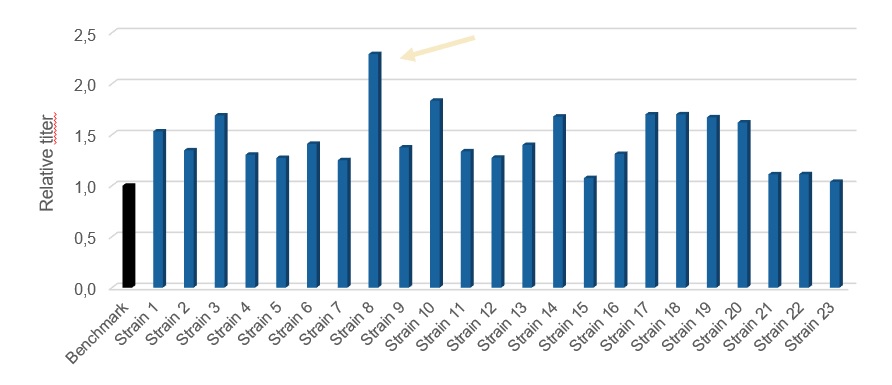
A total of 90 transformants were initially screened, with 23 promising candidates subsequently rescreened to confirm the initial microscale screening results. Among these, strain 8 showed the highest relative product titer and, based on microscale performance alone, would therefore have represented the obvious candidate for subsequent bioreactor confirmation (Figure 1).


Relative VHH titer of 23 Pichia pastoris strains versus benchmark in deep-well plate screening

Figure 1. Microscale cultivation of transformants in deep-well plates for trivalent VHH production. Strain 8 showed the highest relative product titer.

However, occasional exceptions in the transfer from microscale screening to controlled fermentation conditions highlight why production strain selection should not rely exclusively on a single top-ranked clone. For this reason, we generally recommend carrying several high-performing clones from microscale screening forward into bioreactor confirmation. In a typical strain development workflow, several promising clones are evaluated in 1 L bioreactors to confirm their performance under controlled fermentation conditions.
This approach provides a broader basis for production strain selection and reduces the risk of advancing a clone whose strong microscale expression performance does not translate into robust bioreactor performance. At the same time, it reduces the risk of overlooking other candidates that may display a more favorable production phenotype under process conditions.


Controlled microbioreactor cultivation as an intermediate selection step

In cases where a larger number of promising clones are available, controlled microbioreactor cultivations can be introduced as an alternative intermediate selection step. This allows several candidates to be compared in parallel under more tightly controlled and fermentation-relevant conditions, before a smaller number of strains are selected for subsequent 1 L bioreactor confirmation. VALIDOGEN uses the BioLector® Pro microbioreactor system for this purpose. This system enables microscale cultivation with online monitoring and control of key process parameters, including biomass, pH, dissolved oxygen, temperature and feeding.

In the VHH project presented here, 90 transformants were initially screened, with 23 promising candidates rescreened to confirm the initial microscale screening results. From these, nine clones with different productivities were selected for further confirmation under controlled microbioreactor conditions in addition to the benchmark strain without UNLOCK PICHIA tools. 

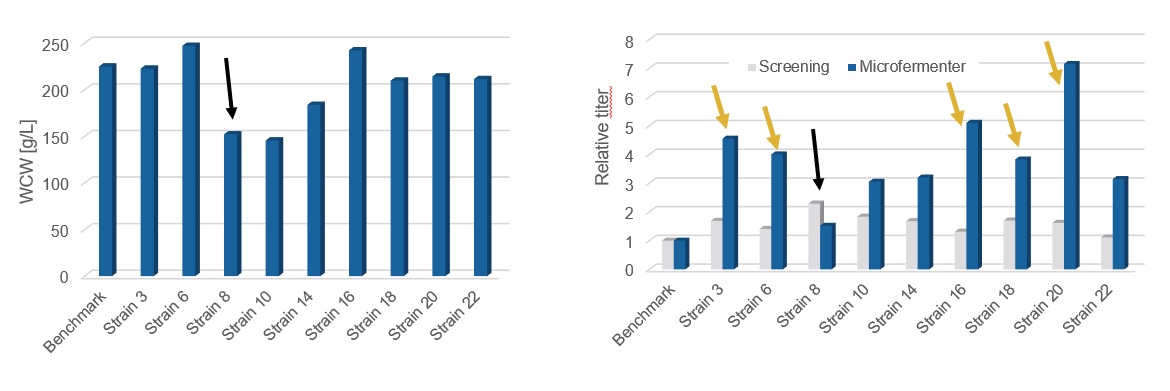
Under a methanol-induced microbioreactor process, the relative performance of the clones changed compared with the ranking observed during deep-well plate cultivation. Several candidates combined high productivity with robust biomass formation, whereas strain 8, the highest-producing clone in the microscale screen, showed strongly impaired growth under the more process-relevant cultivation conditions (Figure 2).


Wet cell weight and relative VHH titer of nine Pichia clones and benchmark in microbioreactor cultivation

Figure 2. Biomass formation (wet cell weight - WCW) and relative product titer of selected clones during methanol-induced microbioreactor cultivation. Clone ranking differed from that observed during deep-well plate screening, with some clones showing impaired growth under process-relevant conditions. Yellow arrows indicate the five best-performing candidates subsequently selected for bioreactor confirmation; the black arrow highlights strain 8, the original microscale screening winner.

The microbioreactor cultivation thus provided an additional basis for prioritizing candidates for subsequent bioreactor confirmation.

Confirmation of six candidates in 1 L bioreactors

Based on the microbioreactor results, the five best-performing candidates together with strain 8, the original microscale screening winner, were transferred to conventional 1 L bioreactors and compared against the benchmark strain without UNLOCK PICHIA tools. Including strain 8 in this confirmation step allows the predictive value of the microbioreactor cultivation to be assessed directly.

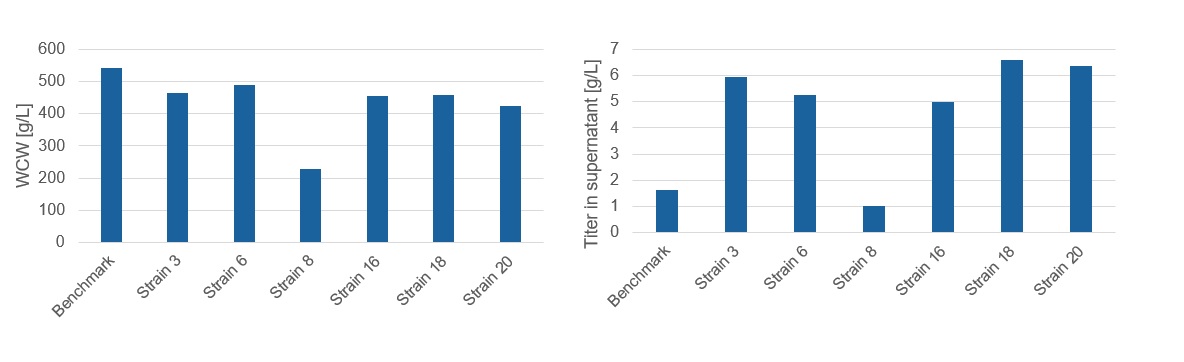
The selected strains demonstrated robust growth, high productivity and good transferability to the larger cultivation system. All five best-performing strains substantially outperformed the benchmark, with the highest product titer reaching 6.6 g/L compared with 1.6 g/L for the benchmark strain, corresponding to a more than fourfold increase in titer through UNLOCK PICHIA strain engineering. 

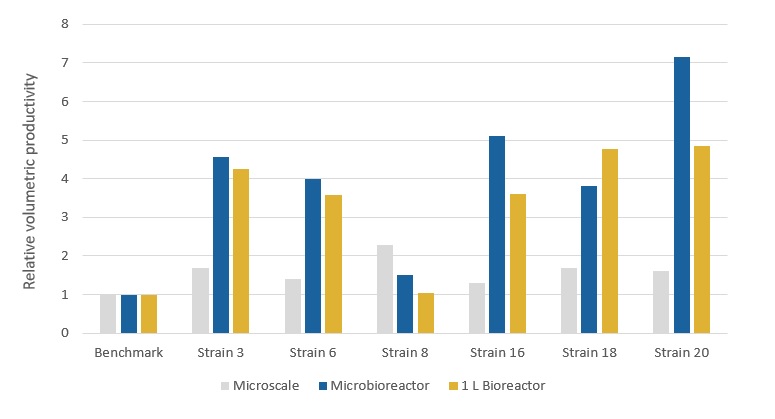
Importantly, the ranking observed during microbioreactor cultivation was largely reflected in the subsequent bioreactor experiments: while strain 18 showed the highest measured titer in cell-free supernatant (Figure 3), strain 20, the best-performing candidate in the BioLector® Pro, was also the best-performing strain in the 1 L bioreactor in terms of relative volumetric productivity (Figure 4). In comparison, strain 8 performed poorly in both systems.

Wet cell weight and VHH titer of six Pichia strains and benchmark in 1 L bioreactors

Figure 3. Confirmation in 1 L bioreactor: biomass formation (WCW) and product titer in supernatant of selected clones during methanol-induced bioreactor cultivation. 

Figure 4 summarizes how relative clone performance changed across the three cultivation stages, illustrating the shifts in ranking as cultivation conditions became increasingly process-relevant.

Relative volumetric VHH productivity of Pichia strains in microscale, microbioreactor and 1 L bioreactor

Figure 4. Relative volumetric productivity for VHH expression across the three cultivation stages, expressed as fold change versus the respective benchmark. 


Comparing production strain performance under process conditions

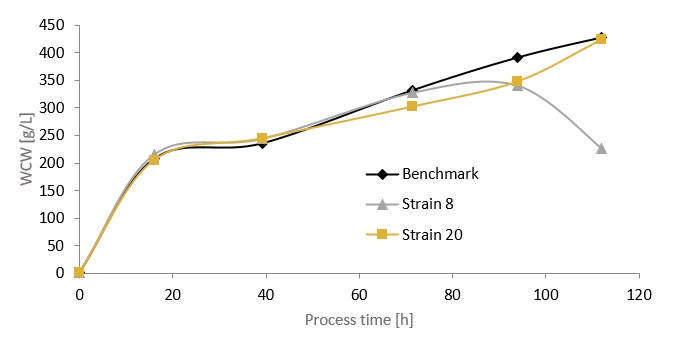
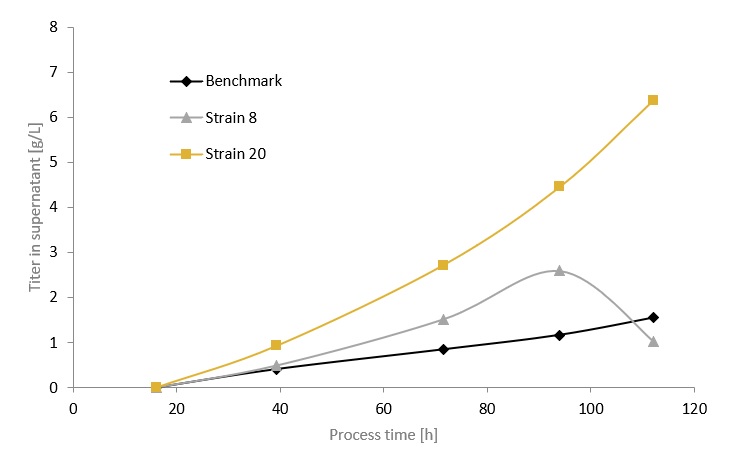
The final comparison between strains 8 and 20 illustrates how clone performance can diverge under controlled fermentation conditions. Strain 8 showed reduced methanol tolerance and consequently impaired biomass formation and product loss, whereas strain 20 maintained robust biomass formation and high productivity throughout microbioreactor and 1 L bioreactor cultivation (Figure 5 a, b).

Wet cell weight over process time for Pichia strain 8, strain 20 and benchmark in the bioreactor

Figure 5a. Bioreactor cultivation of strain 8 and strain 20 compared with the benchmark strain: wet cell weight (WCW) over process time.

VHH titer in supernatant over process time for Pichia strain 8, strain 20 and benchmark in the bioreactor

Figure 5b. Bioreactor cultivation of strain 8 and strain 20 compared with the benchmark strain: product titer in the supernatant over process time.

This direct comparison confirms that initial clone ranking based on microscale titer alone may not always identify the most suitable production strain.

The key principle: confirm several promising clones under process conditions 

Microscale screening provides a reliable basis for identifying a group of high-performing candidates and, in most projects, the relative performance of selected clones translates well to controlled bioreactor cultivation. However, individual exceptions can occur, meaning that production strain selection should not rely solely on a single top-ranked clone.

In a typical VALIDOGEN strain development workflow, several high-performing candidates are therefore carried forward for confirmation under controlled fermentation conditions. They can either be evaluated directly in bench-top bioreactors or, when a broader candidate set is available, first compared in a microbioreactor system.

The BioLector® Pro provides a resource-efficient intermediate selection layer, revealing strain-specific differences before conventional 1 L bioreactor cultivation. In this project, the relative performance observed in the microbioreactor was subsequently reflected in the 1 L bioreactor experiments.

By combining reliable microscale screening with confirmation of several promising candidates under process-relevant conditions, the risk of overlooking a superior production strain or advancing a physiologically less suitable candidate can be reduced. This provides a more data-driven basis for prioritizing strains, reduces uncertainty before further process development and scale-up, and allows development resources to be focused on candidates with the strongest production potential.

Ultimately, microscale screening identifies the most promising candidate pool, while process-relevant confirmation helps determine which of these candidates is best suited as the final production strain.



Aid Atlić, PhD
Written by:

Aid Atlić, PhD

Head of Fermentation Process Development

Aid Atlić is Head of Fermentation Process Development at VALIDOGEN. He studied at Graz University of Technology, Austria, with study and research periods in Italy and Canada. After completing his PhD, he joined VALIDOGEN in 2011.

LinkedIn