
31 g/L Bivalent VHH by Methanol-Induced Pichia Production
Case Study III: Development of a methanol-induced Pichia protein production process for maximization of process performance
VALIDOGEN is pleased to share outstanding results from our latest Case Study III. Applying our PAOX1-driven, methanol-induced UNLOCK PICHIA® process we achieved impressive protein expression levels, reaching 31 g/L for a bivalent VHH in Pichia pastoris.
Key Achievements
- Enhanced strain engineering leveraging UNLOCK PICHIA® technology: By harnessing our UNLOCK PICHIA® toolbox, we developed a high-performance Pichia pastoris strain capable of secreting 21 g/L of bivalent VHH applying one of our generic standard protocols.
- Advanced process optimization: Through sophisticated process development and optimization strategies we achieved a ~50% increase in product titer, boosting final yields to an impressive 31 g/L in just 111 hours cultivation.
Productivity Highlights
- Specific productivity: Improved cultivation conditions through process optimization and scale-up significantly boosted cell performance, resulting in a remarkable ~80% increase in specific productivity.
Case Study III:
We previously published the findings of Case Studies I and II, showcasing the development of methanol-free production processes for the efficient production of a bivalent VHH. Through process optimization, we achieved product yields of 12 g/L in just 64 hours and 19 g/L within VALIDOGEN's standard cultivation time of 111 hours.
These processes demonstrated exceptionally high space-time yields (STY), providing a safe and efficient alternative for protein production processes where methanol needs to be avoided.
Case study III aimed to develop a high-performance methanol-inducible production process for the expression of the same molecule, a bivalent VHH.
Using a VALIDOGEN generic standard protocol 21 g/L of bivalent VHH was secreted in 1 L bioreactors. In an initial development phase existing VALIDOGEN optimization protocols were applied to this strain in small-scale trials. This resulted in an increase of yield to 24 g/L, and a notable improvement in specific productivity.
By subsequently applying a targeted process development and optimization strategy at the 10 L bioreactor scale we achieved an impressive titer of 31 g/L, alongside a remarkable ~80% improvement in specific productivity compared to the standard methanol process. A customized methanol feeding strategy was developed specifically for this strain, enabling both a successful scale-up and further enhancement of productivity.
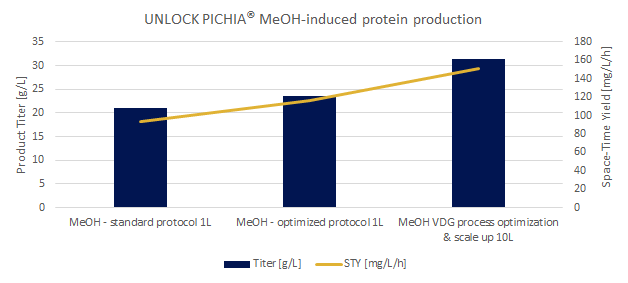
Figure 1: Methanol-induced production of a bivalent VHH using UNLOCK PICHIA®. Product titer (bars) increased from 21 g/L with the standard 1 L protocol to 24 g/L after 1 L optimization and 31 g/L following process optimization and scale-up to 10 L. Space-time yield (line) increased in parallel.
These results demonstrate the exceptional potential of VALIDOGEN’s UNLOCK PICHIA® platform and Pichia expert know-how to develop high-performance protein production processes for commercial application.
Our platform provides extensive customization options, including both methanol-induced and methanol-free expression strategies. This flexibility, combined with our expertise in Pichia process development & optimization, enables us to develop robust, scalable, and economically viable processes that significantly reduce the cost of goods for protein manufacturing.
Contact us to learn more about VALIDOGEN's strain development & process development programs.
Iskandar Dib, Principal Scientist and BD Manager, iskandar.dib@validogen.com
Rosie Maddock, BD Manager, rosie.maddock@validogen.com